What goes wrong without it
Three hundred and forty grams of moong dal at a hundred and twelve rupees a kilo. The man at the counter has to read the scale, type the weight, multiply, and round. He does it two hundred times a day with a queue in front of him.
He will get it right almost every time. Almost is the problem. One rupee lost on a quarter of the loose sales is a number no shop ever sees, because nothing in the shop is designed to show it.
A shop never finds the money it loses one rupee at a time. It only finds the sack that ran out early.
How the scale connects
There are two honest ways to do this and one that is sold as a third.
- Over a cable. The scale has a serial port and the counter reads it. Cheap, old, works forever, and the cable runs across the counter.
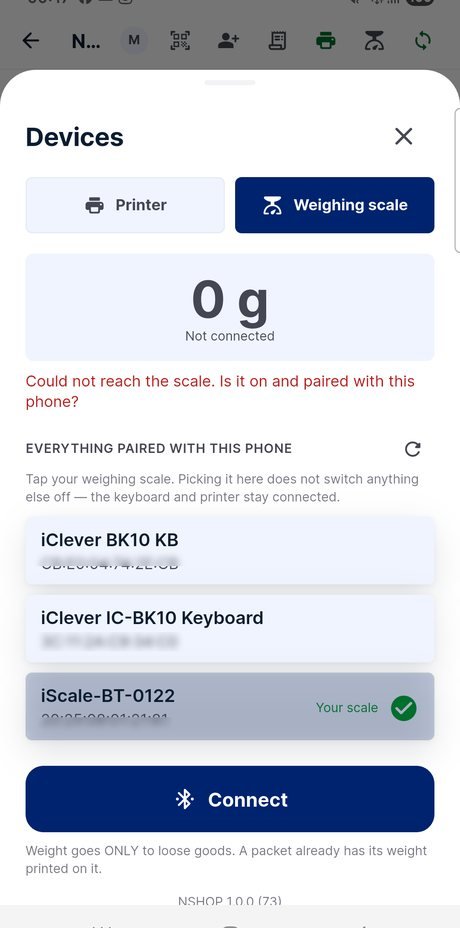
- Over Bluetooth. The scale pairs with the counter once and stays paired. No cable, and one scale talks to one counter at a time.
- A label printing scale. The scale prints a sticker with the price on it and the counter scans the sticker. It works, it costs more, and every rate change means printing the stickers again.
NSHOP reads the scale over Bluetooth on the counter app and over the serial port on a web browser. The shop in Bhilai runs an iScale i 07 on Bluetooth.
Grams or kilos, decided by the item
Chawal is sold in kilos. Elaichi is sold in grams. A shop that has to think about which unit it is in before it weighs anything has been given the wrong tool.
Every loose item in NSHOP carries the unit it is sold in. The stock behind it is always kept in kilos, so the two never drift apart, and the counter never converts anything. Weigh, add, done.
The rate moves in the morning and nothing has to be reprinted
Loose rates move. A sack bought at a hundred and four is sold at a hundred and twelve this week and a hundred and nineteen the next.
If the price lives on a printed sticker, every change is a reprint. In NSHOP the price lives on the item, so the morning rate is one number typed once. Anything already weighed and labelled keeps the price it was labelled at, and everything weighed after it gets the new one.
Is the scale telling the truth
Worth asking twice a year, because a scale that reads five grams light on every sale gives away about one and a half kilos for every three hundred it sells.
- Keep a known weight behind the counter. A sealed one kilo pack is close enough for a daily check.
- Put it on at the far left, the middle and the far right of the pan. The three readings should match.
- Check it cold in the morning and again in the afternoon heat.
- Legal metrology stamping is a yearly job for a trade scale. That is the law, not advice.
What it costs to start
A Bluetooth counter scale is the only extra hardware. Everything else is the phone or the computer already on the counter.
The software side is the monthly price with nothing added for loose goods.
Questions people ask
Can any weighing scale connect to billing software?
No. The scale has to send its reading out, over a cable or over Bluetooth. A plain shop scale with only a display sends nothing, and no software can read a number off glass.
Does the weight go into the bill automatically?
Yes. The counter asks the scale, the scale answers, and the line is written with the price already worked out. Nobody types a weight.
What if the rate changes after something is weighed and labelled?
The labelled packet keeps the price printed on it. Anything weighed after the change takes the new rate. Nothing is reprinted.
How do I know my weighing scale is accurate?
Keep a known weight behind the counter and put it on the pan at the left, the middle and the right. All three readings should agree. Check once cold and once in the afternoon.
Can two counters share one scale?
Not over Bluetooth. One scale pairs with one counter at a time. Two counters need two scales.